
Ethical Standards and Attachment Protocols for Environmental Data
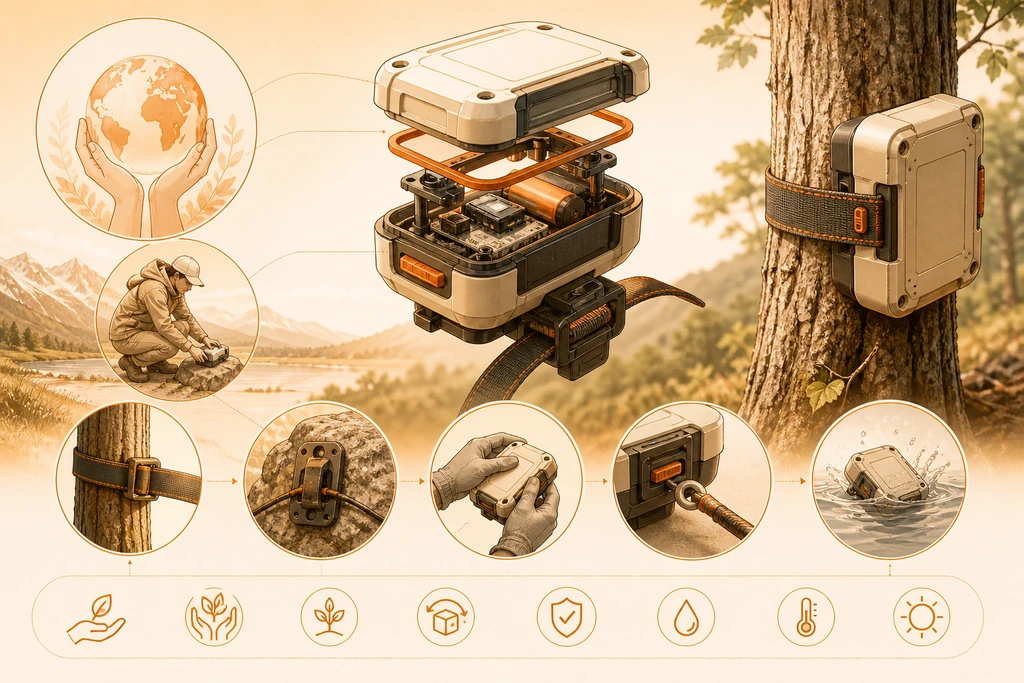
Trust in field data is engineered, not declared, requiring rigorous methodologies from the outset. Ethical standards and attachment protocols for environmental data ensure that every deployed sensor maintains uncompromising integrity. This page explores the intersection of moral accountability and technical precision, detailing how rigorous mounting practices, transparent custody chains, and meticulous field documentation secure reliable insights for researchers and conservationists.
Implementing Ethical Data Collection Protocols
-
Secure Permits and Access Agreements
Begin by obtaining signed access agreements and legal permits before deploying any environmental equipment. This foundational paperwork ensures full compliance and establishes transparent data governance in the field.
-
Calibrate Sensors and Metrology Instruments
Perform rigorous calibrations using equipment traceable to national metrology institutes. Maintaining verified accuracy certificates guarantees that environmental measurements remain reliable and scientifically credible.
-
Mount Hardware Without Habitat Harm
Install data loggers securely using non-destructive hardware and careful physical mounting techniques. Protecting the surrounding environment preserves the integrity of the ecosystem being studied.
-
Maintain Chain of Custody Metadata
Record comprehensive metadata, including photographic evidence and maintenance logs for every site visit. This rigorous tracking ensures complete transparency and accountability from deployment to decommissioning.
Where Credibility Begins
Trust in field data is engineered, not declared. A logger with 0.1 °C resolution is worthless if nobody can prove where it stood, who opened the enclosure, or when the battery was last swapped. Ethical standards and attachment protocols for environmental data begin long before the first sample interval — in permits, paperwork, and a calibrated torque wrench. Experienced practitioners treat three artefacts as inseparable: the sensor, its physical mount, and its metadata trail. A calibration certificate traceable to a national metrology institute, a signed access agreement, and two photographs of the bracket together form one chain of custody. Independent peer reviewers ask for all three before a dataset is accepted. The lesson is unglamorous but reliable: record the serial number, the firmware build, coordinates to five decimal places, and the name of whoever closed the lid. Anyone downstream can then reconstruct your work — or challenge it fairly.
Ethical Standards Beyond Paperwork
Signed permits satisfy regulators; they rarely satisfy the people who live beside a monitoring station. Ethical standards go further than compliance. Before a single stake goes in, the practitioner should be able to answer three questions: whose land is this, whose water flows past it, and who benefits from the numbers collected. Practical consent work looks like this:
- Written permission from the landowner, renewed when tenancy changes.
- A cultural or heritage survey wherever ground disturbance is planned, not assumed to be unnecessary.
- Scheduling around nesting, spawning, or calving windows rather than working straight through them.
Data sovereignty matters too. Communities that host long-term monitoring often expect a copy of the results, a plain-language summary, and a say in how raw records are published. Withholding those is legal but not ethical. Document every agreement with dates and signatures, and honour the exit clause as carefully as the entry one. Establishing ethical standards often requires adopting open-source-data-architectures-for-multi-institutional-ecological to ensure transparent sharing across diverse ecological networks.
Mounting Hardware Without Harm
Hardware choices are ethical choices. A bracket that girdles a growing trunk will kill the tree in four to seven years, long after the project's funding ends. Reputable attachment protocols specify a growth allowance of at least 25 mm per stem diameter increment, wide flexible straps instead of wire, and an annual inspection during the first three seasons. Material specification is equally unforgiving. Use 316 marine-grade stainless for coastal deployments; 304 grade pits within a year in chloride-rich air. Nylon ties must be UV-stabilised, and cutting them flush prevents abrasion on bark and on skin. Sediment enclosures belong on anchors rated for at least twice the expected drag, with a sacrificial zinc anode wherever dissimilar metals meet. Terminate cables with a drip loop and strain relief so that movement loads the gland, not the solder joint. Torque fasteners to the manufacturer's figure — usually 1.5 to 2 Nm for M4 bolts — and re-check after the first thermal cycle.
Core Protocols and Standards for Environmental Data Loggers
| Protocol Stage | Primary Requirement | Compliance Factor | Operational Timeline |
|---|---|---|---|
| Permits and Paperwork | Signed access agreements and permits | Depends on local regulatory scope | Completed prior to field deployment |
| Physical Mounting | Hardware installation without environmental damage | Varies by habitat sensitivity and substrate | Executed during initial site visit |
| Calibration and Custody | Traceable calibration certificates and metadata trails | Dependent on sensor type and metrology standards | Verified at every maintenance interval |
| Field Attachment | Secure positioning using calibrated torque tools | Varies by exposure to weather and currents | Maintained throughout the sampling period |
| Decommissioning | Site remediation and complete hardware removal | Depends on initial permit restoration clauses | Executed at project completion |
Attachment Protocols in the Field
Most deployments do not fail in the sensor; they fail at the point of contact with the world. Ice loading, animal interference, tidal scour, and slow mechanical creep attack the mount first, and the resulting tilt corrupts a pressure record before any electronic fault appears. This is why attachment protocols in the field deserve as much review time as calibration. Recurring failure modes to design against:
- Creep in polymer straps, which loosen tension within two summers.
- Biofouling adding mass and shading to optical sensors.
- Rodent damage to exposed cabling, common near agricultural drains.
Ethical standards and attachment protocols for environmental data also cover vandalism and theft: visible identification, a contact number, and a locked enclosure reduce the chance of a logger being cut down as an unknown device. Inspect quarterly, photograph the mount at each visit, and replace hardware at half its rated service life.
Calibration, Custody, and Checksums
Data is only as clean as the trail behind it. A checksum proves that a file arrived intact; it says nothing about who carried the logger from the wetland to the vehicle. Integrity rests on two parallel records — numerical and human. Calibration should be traceable to a national metrology institute, with a fresh certificate before each season and a drift check on return. A barometric sensor drifting more than 0.3 hPa per year needs factory attention, not a home-made correction factor. Keep the raw file untouched, hash it (SHA-256 is adequate), and maintain a signed log of every download, transfer, and edit. Tamper-evident measures are proportionate, not paranoid. Serialised seals, a dated photograph of the closed enclosure, and time-stamped file names cost almost nothing and settle most disputes before they escalate. When a reviewer asks why an anomalous peak was removed, the answer should be a named person, a date, and a documented rule — not a shrug.
Environmental Data FAQ
What role do ethical standards and attachment protocols for environmental data play in field research?
How should researchers mount sensors without harming the surrounding habitat?
Why is the metadata trail considered as important as the physical logger?
When does the site remediation process typically begin for a monitoring project?
Decommissioning and Site Remediation Protocols
Removal is part of the protocol, and it is the part most often skipped. A logger left on a dead tree in a restored wetland is litter with a serial number. Before drilling the first hole, write the decommissioning plan: who returns, on what date, with what tools, and how the hole is sealed. Practical closure steps:
- Photograph the site from the original reference angle.
- Fill drill holes with a wooden plug and non-toxic sealant, never expanding foam.
- Remove all cable, ties, and flagging; weigh out what you weighed in.
Hand the host community a copy of the final dataset and a short summary, rather than a raw archive they cannot open. Ethical standards and attachment protocols for environmental data are judged at the end of a project, not at its start, because exhaustion is when shortcuts start to look reasonable. Build the exit into the schedule and the budget, and the reputation survives the study.