
Advances in Satellite Telemetry and Sensor Miniaturization for Field Teams
Modern scientific expeditions rely heavily on advances in satellite telemetry and sensor miniaturization for effective field research. This page explores how shrinking payloads and improved orbital relays allow scientists to monitor wildlife and environments with unprecedented precision. Discover how lighter hardware, innovative power management, and advanced sensor integration continue to reshape remote data collection protocols.
A Decade of Shrinking Payloads
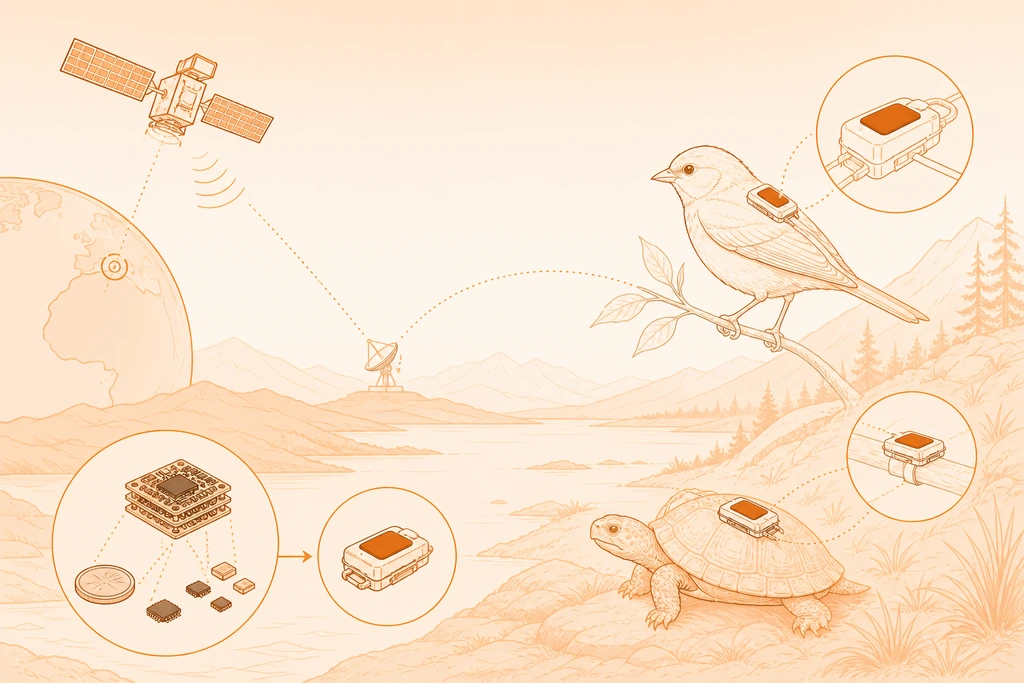
Have you noticed that a complete tracking payload now weighs less than the spare battery pack researchers once carried? Fifteen years ago a GPS collar for a mid-sized mammal typically massed 300-400 g and ran for eight months on primary cells. Today comparable units sit near 80-120 g with two-year duty cycles, and a 1U CubeSat bus of 10 x 10 x 11.35 cm can host an S-band transmitter, a GNSS receiver and a magnetometer. That shift is not cosmetic. Lower mass widens the pool of species that can be tagged without breaching the conventional 3-5% body-mass guideline, and smaller boards draw less current, so solar harvesting becomes viable on platforms where lithium packs alone were marginal. The same physics that miniaturized consumer electronics - finer lithography, system-on-chip integration, cheaper MEMS - reached environmental sensing later, but it arrived. The consequences for study design are substantial, reducing handling stress for study animals while dramatically extending continuous observation windows across remote habitats. These ultra-light sensors originally designed for biology have since expanded, fueling innovations seen from-wildlife-tracking-to-athlete-performance across human motion tracking.
Key Parameters of Modern Tracking Hardware
| Technical Parameter | Field Research Standard |
|---|---|
| Typical mass for mid-sized mammal GPS units | Eighty to one hundred twenty grams |
| Standard duty cycle duration for modern payloads | Up to two years of continuous operation |
| Maximum recommended body-mass ratio for tagged subjects | Three to five percent of total weight |
| Standard CubeSat bus dimensions for remote relays | Ten by ten by eleven point thirty-five centimeters |
Telemetry Advances in Plain Numbers
The compression is measurable. A mid-2000s Argos-class platform transmitter weighed 40-60 g and drew roughly 400 mW at transmit; current modules fall under 10 g with peak draw near 1 W but millisecond bursts that cut average consumption to single-digit milliwatts. Memory tells a similar story: 64 kB of storage once justified a separate board, while microcontrollers now ship with 1 MB flash and integrated radios.
- Payload mass: down 60-80% across collar, buoy and balloon classes.
- Sleep current: from microamps to hundreds of nanoamps on modern sensor hubs.
- Message size: Short Burst Data caps at 340 bytes, forcing efficient encoding.
Those constraints matter because the advances in satellite telemetry and sensor miniaturization for distributed networks are as much about protocol discipline as silicon. A smaller tag is only useful if its link budget still closes at the horizon angle where satellites actually pass, and if its duty cycle respects the spectrum it shares with hundreds of neighbors.
Satellite Telemetry Insights
A decade of shrinking tracking payloads
Store-and-forward relays in orbit
Sensor fusion cuts downlink volume
Store-and-Forward Relays in Orbit
Orbital relay capacity has changed the calculus as much as the hardware on the animal. Nanosatellite constellations in low Earth orbit, typically 400-600 km, offer revisit windows measured in hours rather than the multi-day gaps typical of polar-orbiting weather platforms. Store-and-forward architecture means a tag can transmit blind, log the timestamp, and let the satellite deliver the packet when ground stations next make contact. Doppler positioning from unmodulated carrier signals can locate a transmitter to a few kilometers without any GNSS chip at all, which saves both mass and power on the smallest units. The trade-off is latency and contention. Hundreds of tags sharing a 401 MHz window collide unless transmission schedules are randomized, and a two-hour pass window may still yield only a handful of successful packets. Designers therefore treat contacts as scarce events, not streams, and encode the most valuable data first.
How Sensor Fusion Cuts Downlink
A modern inertial and environmental stack fits on a board under 20 mm square. Triaxial MEMS accelerometers sample at 100 Hz while drawing under 10 uA in low-power modes; magnetometers add heading to about 1 degree after hard-iron calibration; barometers resolve altitude to roughly 10 cm, enough to detect flight altitude in soaring birds or wave height on drifting buoys. Fusing these channels on-device, rather than streaming raw counts, reduces downlink volume by one to two orders of magnitude. Calibration remains the weak point. Magnetometer offsets drift with mounting hardware, gyroscope bias wanders with temperature, and humidity sensors need reconditioning after long deployments. Firmware that flags suspect calibration windows is worth more than a higher-grade sensor, particularly when recovery is uncertain, every field visit costs a full day of helicopter time and a failed attempt can cost an entire season.
Power Budgets Set the Ceiling
Every design decision eventually resolves into joules. A 5 g solar panel at 20% efficiency yields perhaps 30-60 mW under good irradiance, which sounds generous until a single uplink burst consumes a full day of harvest. Primary lithium thionyl chloride cells remain the default for sealed, unrecoverable tags because they hold charge for a decade and tolerate -40 C, while rechargeable lithium polymer suits platforms that see regular sunlight and can be serviced. Duty cycling delivers more than chemistry. Adaptive scheduling that transmits only when a satellite pass is predicted, combined with accelerometer-triggered wake logic, can stretch a two-year target to four. The advances in satellite telemetry and sensor miniaturization for power-constrained deployments therefore hinge on firmware behavior, not component selection alone. Teams that model consumption in microamp-hours per day, rather than milliamps, tend to catch budget failures before deployment instead of during it, when the tag is already sealed and gone.
Barriers Miniaturization Hasn't Removed
Miniaturization has not removed institutional friction. Transmitting in protected bands such as 401-406 MHz requires coordination through national administrators and, for cross-border studies, ITU filings; unlicensed ISM bands at 868 and 915 MHz come with duty-cycle limits that vary by jurisdiction. Export controls on encryption and on certain GNSS modules can delay shipments by weeks, and wildlife permits rarely move faster than the hardware. Physical constraints persist as well. Antennas shortened to fit a 10 g package lose efficiency and detune when placed against tissue or salt water, so a nominally adequate link can fail at the first molt or storm. Encapsulation that survives hydrostatic pressure often blocks the acoustic channels some sensors rely on. Field teams should budget a validation deployment of at least four weeks before committing a full season, and should treat a 70% packet delivery rate as a realistic baseline rather than a malfunction.
Deployment Discipline Still Decides
None of this hardware compensates for weak field protocol. Before a season starts, three checks repay their cost: a bench soak at expected ambient temperature for 72 hours, a link test at the lowest realistic elevation angle, and a documented calibration record tied to each unit's serial number. Rigorous deployment checklists treat these as gating items rather than suggestions, because a silently drifting sensor produces data that looks plausible and is wrong. Data handling deserves equal rigor. Log raw counts alongside processed values, timestamp with a monotonic clock, and record firmware version per device. Where the advances in satellite telemetry and sensor miniaturization for long-duration studies have changed practice most is in volume: a hundred tags now generate what a thousand once did, and the bottleneck has moved from collection to validation, provenance and archiving. Capture is the cheap part now.